
Industrial Renovation and Infill Construction in Downtown Cheyenne and the Depot District
Stormwater decides downtown work before structure does. On August 1, 1985 a hailstorm and flash flood put Dry Creek, Crow Creek and the downtown blocks under water. The National Weather Service logged 6.06 inches of rain, a Wyoming 24-hour record, hail up to 2 inches, 12 deaths and more than $61 million in damage. That history is why we start every downtown job with a drainage review, and why owners in the Depot District should expect a detention and conveyance question in plan review before anyone asks about finishes.
We build and renovate in dense blocks: shell repairs, roof and envelope replacement, tenant space, selective demolition and the slabs and utilities under all of it. Industrial users come downtown too, for rail adjacency, for storage near the line and for shop space that a plant campus does not offer. The industrial renovations and modernization trade crews work in occupied buildings, and our stormwater detention and drainage scope tackles the water first.
A district built on rail and still pulling investment
The Downtown Cheyenne Historic District covers 205 acres and 67 buildings. The Wyoming State Capitol was built between 1886 and 1890, and the Union Pacific Roundhouse, Turntable and Machine Shop district adds another 113 acres in the city. Old masonry, old rail yards and old foundations define what is under the ground here. We assume unmarked utilities, abandoned lines and fill of unknown quality until potholing and borings say otherwise.
The City of Cheyenne's Downtown Development Authority reported in its Q3 2025 update a $3.5 million 6th Penny Large Projects Gap Financing Program aimed at long-vacant sites, with apartments, ground-floor retail and Class A office as possible uses. It also reported a 4-Alley Project and on-street parking designs 75% complete. Owners using gap financing need a builder who can give early cost certainty, since the subsidy usually depends on a hard number.
Hail, rail and the neighbors
Storm risk is a safety plan item. A storm on August 1, 2025 dropped about baseball-size hail on downtown Cheyenne and damaged vehicles, homes and trees. For us that means hail-rated roof assemblies on buildings we touch, protective cover for open work during storm season and a rule that nothing sits unsecured in the lay-down area overnight. Sheet material, scaffolding and loose insulation go airborne in a wind event.
Working near the railroad adds its own requirements. Excavation, crane swing and material staging near the right of way require the railroad's approval, and flagging when work is within the clearance envelope. We bring that into scheduling at the start, not the week before the pick. Pedestrian protection, covered walkways and spotters keep the public clear of work zones on tight sidewalks.
What we do in an old downtown block
Most downtown jobs start with an existing structure that needs an industrial-grade upgrade. Common scopes are structural repair of bearing walls, new slabs on grade where floors have failed, mezzanine and platform insertion and new service entrances for power and fire water. Where a building is beyond saving, our industrial demolition services take it down in controlled sections, sort the materials and leave a clean pad.
Infill construction is the other half. A vacant lot is a small site with no laydown, a narrow street and a neighbor on each side. We plan deliveries by the hour, excavate to the foundation line only, and use sheeting where an adjacent wall is close to the cut. Tenant fit-out follows the shell; our industrial tenant improvements work handles the mixed-use end.
Historic fabric, current codes
A building in a historic district that is renovated for a new use has to meet the current International Existing Building Code as well as fire and life-safety provisions. The state adopted the 2024 International Codes on June 28, 2024, and Laramie County adopted its 2024 International Building Code effective January 1, 2025. The county page does not confirm the City of Cheyenne's own adoption, so we confirm with the city building department which edition governs a downtown parcel.
Wyoming Statute 35-9-121 delegates enforcement to qualifying counties and municipalities, and a locality must adopt or maintain standards at least equal to the state's within six months of a code update. That local enforcement means one downtown address can sit under different amendments than a site just outside city limits. We get the written determination, then price.
From the Depot to the edge of the grid
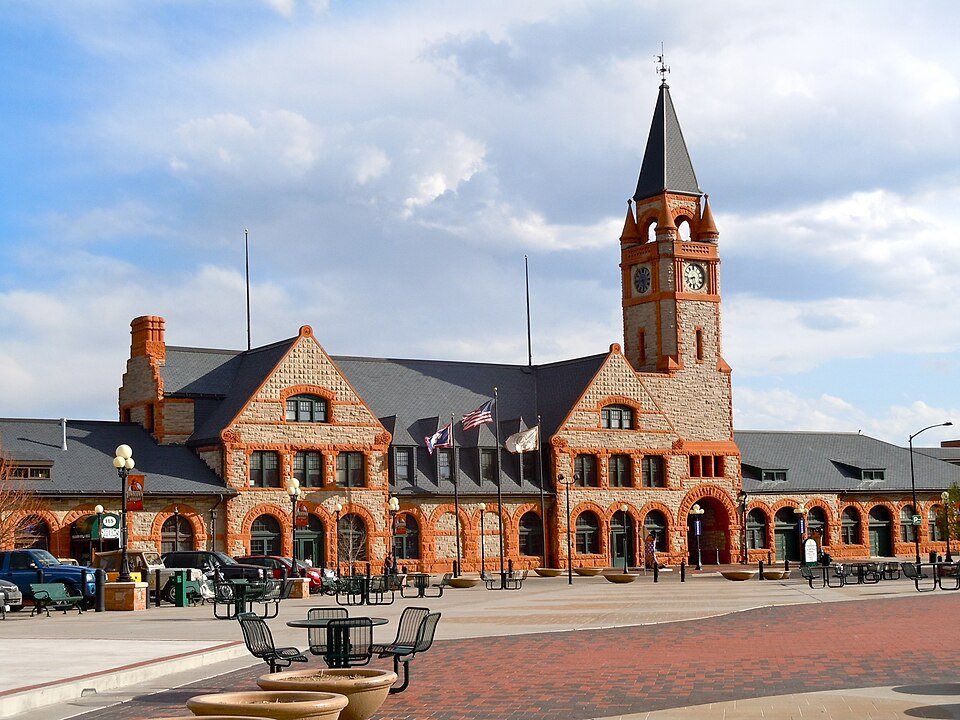
The Cheyenne Depot at 121 West 15th Street was built in 1887 and was designated a National Historic Landmark in 2006. It received a $6.5 million city improvement during renovations from 2001 to 2006 and now houses a railroad museum. We use it as the reference point for how rail and city fabric sit together here. Our downtown service area runs outward to the Hitching Post district and to greater Cheyenne, where plant and warehouse work picks up.
Rail users who want more than adjacency can look at rail spur site improvements, which cover grading, ballast, ties and crossings on private track. That is a different scope than downtown, but many owners use both: a downtown office for operations and a yard on the edge of town for freight.
Pairing downtown work with site work
An owner investing in an old building often needs adjacent work too: a parking lot, a loading apron, a fence line or utility upgrades. We bid those together to avoid two mobilizations. Downtown projects involving office space can also link to office building work, where the interior scope is conventional but the structure and utilities are not.
Some logistics tenants want a foothold in the city center. Operators in logistics and distribution use downtown space as a small-scale hub or an administrative base, and want dock-height access and secure parking added to older buildings. We design those retrofits so they do not trigger a full code upgrade on the whole building when a smaller scope will do.
Start with the drainage review
Send us the address and the intended use. We will return a site-conditions checklist, a stormwater approach and a phased budget.
Common Questions
How does downtown flood history affect a new project?
Reviewers look hard at drainage. The 1985 flood put 6.06 inches of rain on the city in 24 hours, so a new building or addition is expected to show where stormwater goes and how it leaves the site. We price detention, grading and overflow routes from the start so plan review does not turn into redesign.
Can we use the city gap financing program with a fixed-price contract?
The program is aimed at long-vacant downtown sites and depends on documented costs. A guaranteed maximum price or a fixed-price bid gives the lender a number to underwrite. We prepare a line-item estimate that matches the format a financing reviewer asks for.
What is the biggest risk in renovating a building near the rail yards?
Unknown underground conditions and railroad approvals. Old foundations, fill and abandoned lines show up on almost every dig, and anything near the right of way needs railroad coordination. We investigate early and put both in the schedule instead of treating them as surprises.
Do hail events change how you schedule roofing?
Yes. Roof replacement is planned in small sections that can be dried in each day, with temporary protection staged on site. In the summer months, we watch the forecast daily. An open roof with hail forecast is a stop-work condition.
Will a historic district listing limit what we can build?
Listing affects exterior changes and can add review steps for work visible from the street. Interior industrial upgrades and rear-of-building service work are usually less constrained. We check the district rules with the city before design begins and list any review time in the schedule.
Related
Related Services
Related Building Types
Related Industries
Related Service Areas
Ready to talk about your project?
Service Areas
-
Cheyenne
Ground-up plants, data center support, slabs, pads and site civil for Cheyenne owners. We build to local frost, wind and snow criteria. -
Laramie
Light manufacturing, flex and metal buildings in Laramie at 7,165 ft. We plan frost, wind and long hauls into every pour and erection date. -
Wheatland
Equipment pads, heavy-haul roads and phased work beside an operating plant in Wheatland, Wyoming. We plan around outages and I-25 hauls.