Rail Spur Site Improvements at Cheyenne Industrial Sites
One business park in Cheyenne is rail served, and the local economic development agency says so in plain terms: the Cheyenne Logistics Hub, about 2,000 acres southwest of town with access to both BNSF and Union Pacific, I-80 and I-25. Cheyenne Business Parkway is listed as not rail served. If your process moves bulk product, steel coil, aggregate or fertilizer in railcars, the parcel you pick decides whether a spur is even possible.
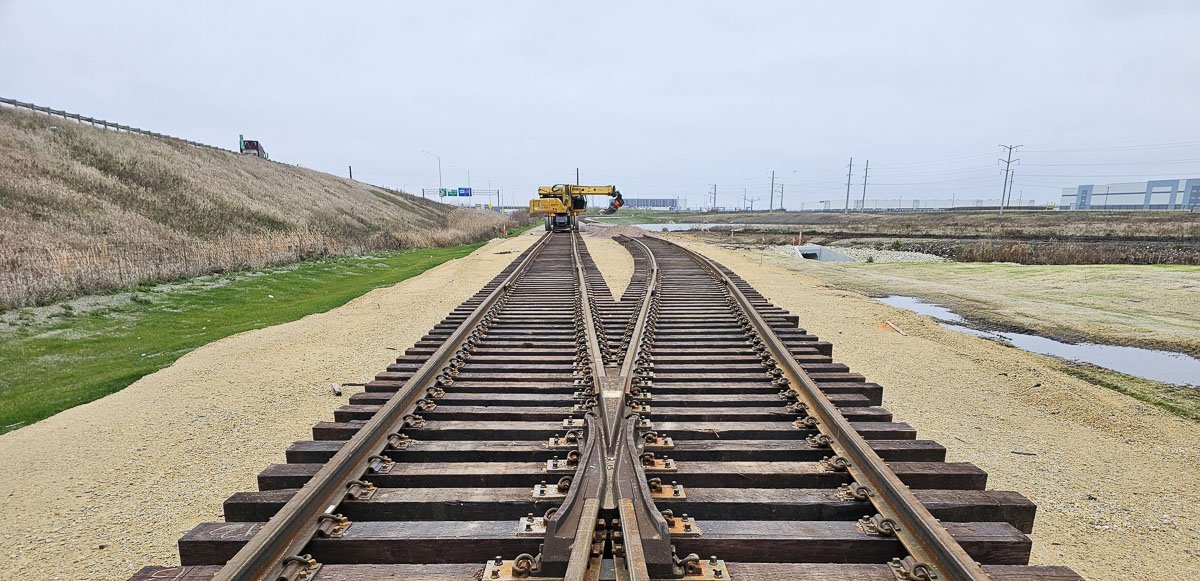
We build the site side of rail: the grading, drainage, subballast, ballast, ties, rail, turnout connection, crossings, bumper posts and the loading pads around them. The railroad owns the right to approve the connection and sets the standards for the switch and the lead. We build the track to those standards and to the plant's own needs, and we coordinate the paperwork so the spur does not become the last item holding up startup.
A spur is expensive per foot and slow to permit, so the decisions that matter come early: track length, number of cars, where the loadout sits, and how the spur lines up with the building and the truck court. We work those out with your logistics lead before the site plan is frozen.
Rail access in this market
Union Pacific and BNSF both operate railyards in Cheyenne, and their lines cross here. The I-80 corridor runs along a major internet backbone that follows the Union Pacific right of way, which is part of why data center and heavy industry buyers look at the same ground. At the hub, the listing cites a short-line operator, transloading and railcar storage already on site.
That matters for how we plan. If a short-line switching operator already runs the hub's tracks, your spur can tie into an existing lead and avoid building a connection to the main line from scratch. If you are further out and need a direct connection, the railroad's engineering review and its construction schedule drive the timeline more than we do. We tell you which case you are in before you buy.
What the track package includes
The package starts with survey and a track design that fixes curve radius, grade, clearances and turnout location. Grading follows, with a drained, compacted subgrade, often capped with geotextile and subballast, because track that sits in wet clay pumps mud up through the ballast and loses line and surface. Ballast, ties and rail go on next, welded or jointed as the railroad specifies, then the turnout, the derails, the bumper post and any signal or crossing protection.
Around the track we build the working areas: concrete or hardened aprons at the unloading points, containment where liquids are handled, lighting, and the haul road for trucks that transload. Where the spur crosses a plant road, we build a crossing panel or concrete crossing rated for the road load and install warning devices when the road is used by the public. Drainage along the track gets as much attention as the track: ditches, culverts under the lead, and a clear outfall, since standing water at the tie ends is the commonest cause of track that needs constant surfacing.
Water, cars and clearances
A big rail user brings water questions with it. Council members raised water supply as a key question when a proposed nitrogen fertilizer plant (2.5 million metric tons a year of urea, UAN and diesel exhaust fluid) was floated for the hub, including whether it would use the city system or its own well drawing on the county aquifer. No site is chosen, but the question is real for any heavy user. We design drainage and fire water with that in mind and look at fire water loops early.
Track length and car count also set the footprint. A string of 20 cars does not fit a short pad; a loop track and a siding with room for switching do. We lay out clearances for tall loads, walkways beside the track, and space for the locomotive to run around the cars. Every spur has to be engineered against the real cars you expect, not a generic drawing.
The railroad sets the pace
The industry track agreement, plans review and the railroad's own work on the turnout all happen on the railroad's calendar. We submit plans early, answer comments the day they arrive, and keep the grading and subgrade work ready to go once the approval lands. Long-lead items, including rail, ties and turnout material, go on procurement tracking from day one.
Weather limits ballast work in deep winter, so we aim to have the subgrade and drainage complete before freeze-up and set track in the first workable window. Spring thaw softens the grade, so we hold heavy tamping equipment off the line until the base firms up and re-check line and surface before the first loaded car. For warehouse buildings or bulk operations with a spur, start-up date and first railcar date should be agreed with the railroad in writing, since a late switch usually means demurrage or truck diversion.
Approvals and standards
Track construction follows the railroad's standard plans and recognized engineering practice, and the connection needs a signed agreement with the carrier. The county side runs through the usual grading and drainage review. Laramie County adopted the 2024 International Fire Code effective April 15, 2025, and fire access around any loading building, tank or storage area has to fit it. We show hydrant coverage, apparatus access and the width of the road beside the track on the same sheet as the track plan, so the fire reviewer sees how the whole yard works instead of one piece at a time.
Environmental permits can be heavier than the track itself: stormwater, spill prevention for liquid loading, and any air or process permits for the plant. We assemble the site-side documents and work with your environmental consultant so they line up with the drawings.
Bring the railcar count
Tell us the cars per week, the commodity and the parcel. We will tell you whether a spur works, what it costs to approach, and how long the railroad review will run.
Common Questions
Can I build a spur at Cheyenne Business Parkway?
The park is listed as not rail served, so a spur there would require a new connection and likely easements across other property. That can be done in principle, but it is a long approval and an expensive build. If rail is central to your process, the Logistics Hub is the practical choice.
Who builds the turnout, the railroad or you?
Usually the railroad builds and owns the turnout and the portion on its right of way, and bills the customer. We build the lead and the yard tracks on your property to the railroad's standards, and coordinate the cutover.
How long is a typical rail spur approval?
Plan on months, not weeks. The railroad reviews the track layout, the operating plan and the commercial agreement. The earlier you submit, the better.
Do we need transloading if we have our own spur?
Not always. Transloading helps when your volume is uneven or you want to receive rail without building your own track. We can build a transload pad on your site and connect it to the spur later.
What does winter do to track construction?
Deep frost stops grading and ballast tamping, and snow hides conditions. We finish subgrade and drainage in fall, set ballast and track in the first good window, and plan on a punch list in spring.
Related
Related Services
Related Building Types
Related Industries
Related Service Areas
Ready to talk about your project?
Industrial Construction Services
-
Ground-Up Industrial Construction
Ground-up plants and industrial buildings in Cheyenne and Laramie County, built around utilities, slab spec, wind load and a 36 inch frost line. -
Industrial Design-Build
One contract for design and construction of Cheyenne industrial plants, with guaranteed pricing, early utility release and closely managed site work. -
Industrial Preconstruction Services
Site feasibility, utility review, estimating and scheduling for Cheyenne industrial projects, priced on real quantities before design is frozen.