
Heavy-Haul Access Roads for Cheyenne Industrial Sites
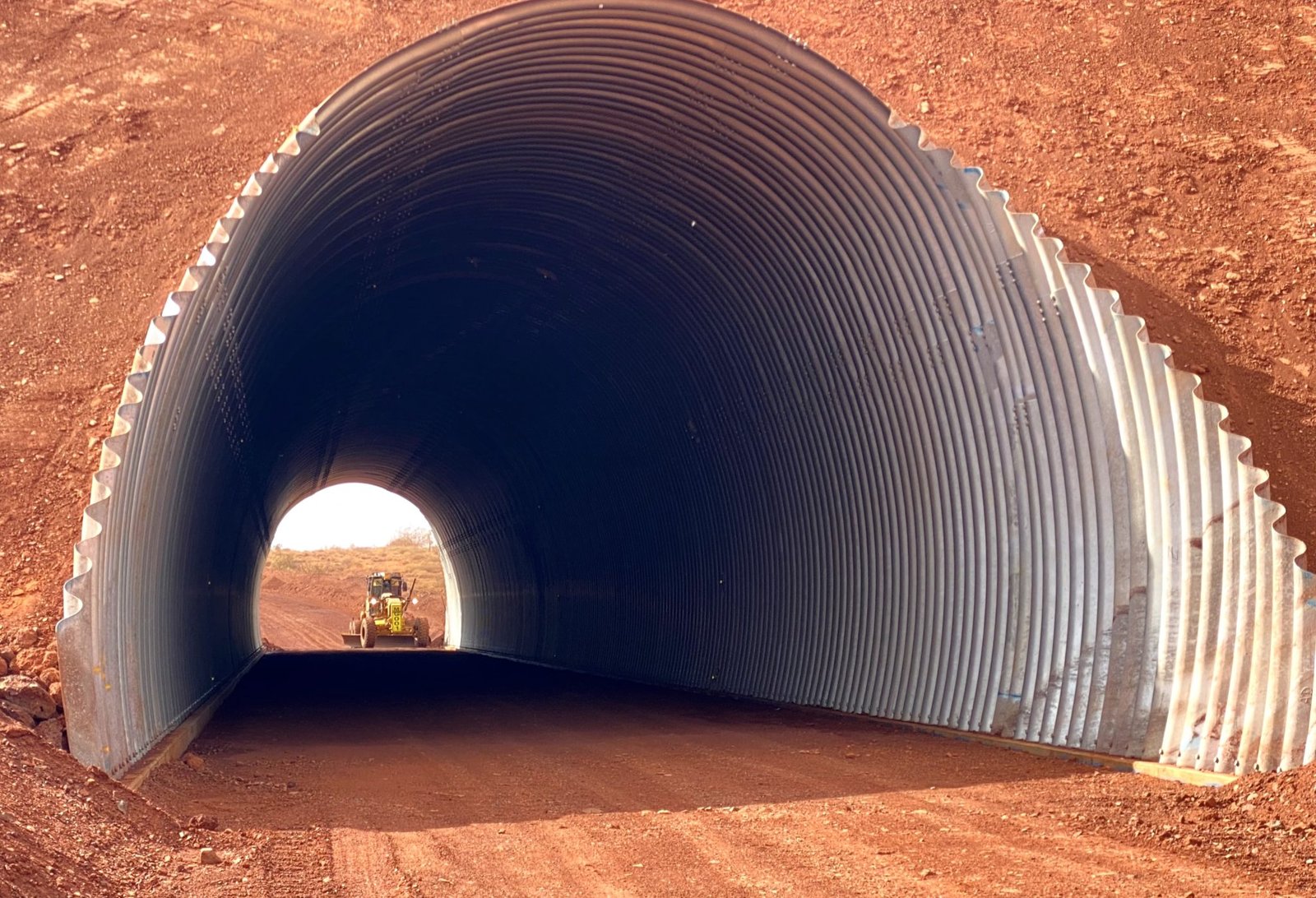
Seven bid packages, 246 construction jobs and a new 4.5-mile road: that is what it took to open the High Plains Business Park for its first tenant, and the road came before the building did. Heavy-haul access roads are the part of a site that decide whether a module, a transformer or a 100-ton precast panel gets to the pad on the day it is due. We build them for heavy industry and other owners in Cheyenne and Laramie County, as temporary construction routes or as permanent plant roads.
A haul road carries a single heavy axle load many times, which is a different problem from an ordinary street. Rutting, pumping and edge failure show up quickly where subgrade is soft or the section is thin. We design the road to the load and the count: how many loaded trips, at what axle weight, in which season, and for how long. A construction road that only has to last a year is a different product from a plant road that serves forty.
Grade comes before looks. Slope, turning radius and the entry to the highway control what your carriers can run, and we set them to the longest, widest load on the delivery list.
Build the road for the heaviest axle on the list
We begin with the load list. Whoever is buying the equipment gives us weights, dimensions and delivery dates, and we work backward from the worst case. Turning radius is set by the longest trailer. Grade is set by the heaviest tractor with its load. Width includes room for a pilot car and for passing at the turnouts, because a one-lane road fails when a truck breaks down on it.
The structure is subgrade improvement, geotextile or geogrid where the soil calls for it, a thick compacted aggregate base, and a surface chosen for service life. For a one-year construction road, a heavy aggregate wearing course is common. For a permanent road, we place asphalt or concrete over the same base, and we leave culvert crossings and utility trenches in a state where the final paving does not have to cut them. That sequencing keeps the haul road from becoming a patchwork in its second year.
Freight corridors set the standards
The interchange where I-25 meets I-80 is the busiest freight hinge in the area. The state estimates a rebuild at about $500 million, with design running to 2027 and construction taking at least six years in phases. Heavy trucks account for 17% of its crashes, against about 4% at other interchanges nationally. For a plant owner, the lesson is practical: the public road system near the junction will be under construction for a long time, and your private access road has to absorb the detours and queuing that result.
We lay out plant entrances to keep queued trucks on the property and off the public road. That means a long enough throat, a staging lane, a truck court sized for the turn, and a gate set back from the highway. Cheyenne's US 85 and the signal added at the High Plains site are the kind of public improvements an access road ties into, and we coordinate the tie-in with the highway agency's permit and traffic control requirements.
Entrances, approaches and county review
Any new access onto a state highway or county road needs an approach permit, and the review looks at sight distance, turning paths and drainage. Laramie County, which adopted the 2024 International Building Code with amendments effective January 1, 2025, handles the building side, while the road side runs through the highway and public works offices. We file the approach package, prepare the traffic control plans and meet the conditions the reviewers set.
Pavement design follows the geotechnical report. For haul loads we use equivalent single-axle load counts and a structural number, not a standard street section. We test the subgrade, the base and the surface for density and thickness as we build, and keep the records, because a permanent road paid for by an owner is later inspected and accepted by the city or county if it is dedicated, or by your own engineer if it is private.
Pilot cars, spotters and public road work
Oversize loads on a site road put drivers, spotters and walkers in the same place. We build in physical separation: a marked pedestrian route, barrier at crossing points, and a controlled gate with a radio check-in. Where the haul road meets a public road, we plan flaggers, signage and a deceleration lane for the turn.
Winter adds ice and blowing snow to the list. We lay out snow storage and keep a plan for sanding and plowing at the shoulders, so a truck is never asked to climb a glazed grade with a full load. Dust control runs through summer with water and palliatives, and wash-down strips keep mud from tracking onto the highway, where it becomes a citation and a hazard.
Where the money goes on a haul road
Length and thickness, as with any road, but with two extra items. Haul distance for aggregate can double the base cost on a remote site, and we compare pit sources during estimating. Subgrade condition decides whether you need stabilization, which adds cost per square yard but can save more in avoided base thickness. We price both.
Temporary versus permanent is the other lever. A road designed to be reused as the plant's permanent drive costs more at the start and far less over the life of the site. If your laydown yard and your rail spur share the corridor, we price them as a package, since survey, grading and drainage work overlap.
Open the road before the first delivery
The road has to be done before steel, switchgear and large cooling equipment are scheduled to arrive. Working back from the delivery date, we allow for a settling period after grading and a compaction test before the first heavy load. A road opened untested usually costs more to fix than it saved in schedule.
For the typical Cheyenne year, we aim to build roads between spring thaw and the first hard freeze, then maintain them through the winter with plowing and blading. If the schedule demands winter construction, we use frozen-ground methods and keep the cuts open only as long as one day's work can finish.
Send us the load list
Give us the heaviest axle weight, the longest trailer and the first delivery date. We will return a road section, an approach plan and a schedule.
Common Questions
How wide should a haul road be for heavy loads?
A single lane for oversize loads is commonly 16 to 20 feet with shoulders, and 24 feet or more where two-way traffic is expected. The deciding factor is the widest load plus the pilot car, so we ask for the transport permits before we set the width.
Can the construction haul road become the permanent plant road?
Often, if we build the base thick enough from the start and leave utility crossings in place. The cost is higher at the beginning, but you avoid tearing out and rebuilding the road in the middle of operations.
What does the approach permit process look like?
We submit a drawing showing sight lines, turning paths, drainage and signage to the highway or county authority. Review times vary, so we start the package early and keep the schedule open for revisions. Once approved, conditions go on the construction drawings.
How do you handle frozen ground when building a road?
We avoid placing base on frozen subgrade where possible. If we must, we thaw or remove the frozen layer, or use cement or lime treatment, and then compact and test before we continue. Placing base over ice lenses is a recipe for spring failure.
Do you coordinate with trucking companies?
Yes. We ask carriers for their trailer configurations and permit routes, then confirm turning radii, grades and gate widths against them before the road is paved.
Related
Related Services
Related Industries
Related Service Areas
Ready to talk about your project?
Industrial Construction Services
-
Ground-Up Industrial Construction
Ground-up plants and industrial buildings in Cheyenne and Laramie County, built around utilities, slab spec, wind load and a 36 inch frost line. -
Industrial Design-Build
One contract for design and construction of Cheyenne industrial plants, with guaranteed pricing, early utility release and closely managed site work. -
Industrial Preconstruction Services
Site feasibility, utility review, estimating and scheduling for Cheyenne industrial projects, priced on real quantities before design is frozen.