
Truck Courts and Trailer Yards in Cheyenne
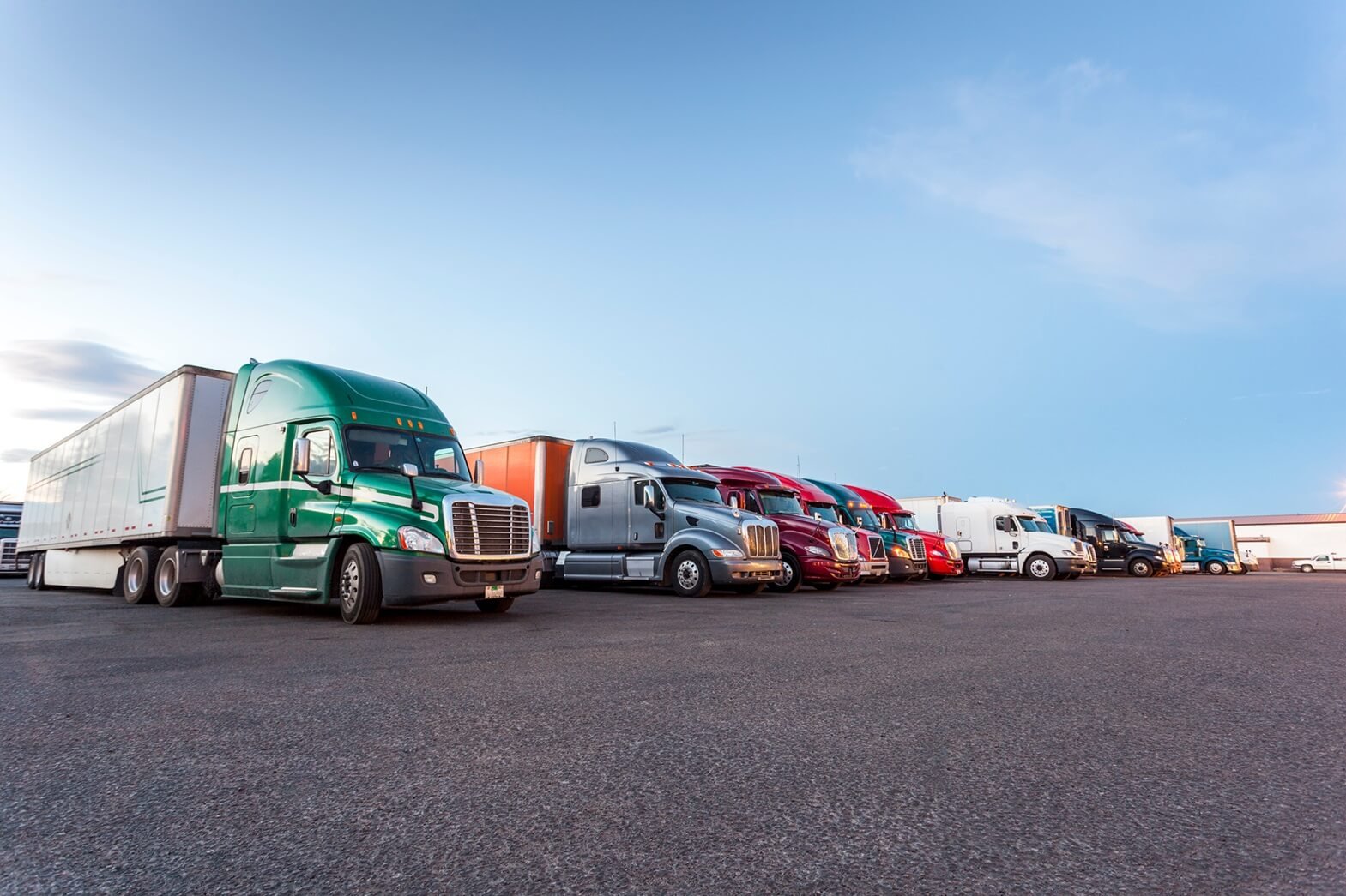
At the I-25 and I-80 interchange, heavy trucks account for 17% of crashes, against about 4% at interchanges nationally. That interchange has logged 160 collisions counting from 2018. Trucks are the traffic in this city, and a truck court that works at 2 a.m. in a crosswind with ice on the pavement is the standard to build to. Your yard is the place where a driver either turns cleanly or does not.
We build truck courts, trailer parking, drop yards, staging lanes and queue lanes for plants, distribution centers and terminals. The work covers geometry, subgrade, base, pavement, striping, drainage, lighting conduit, bollards, curbs and wheel stops.
Concrete is the default for courts that carry loaded trailers, repeated turning and dock-door traffic. Asphalt serves lighter lanes and long approaches. We specify each section by load, turning and drainage, not by habit.
Why yards here are built the way they are
Traffic to Cheyenne's industrial parks arrives by interstate. North Range Business Park has its own interchange onto I-80 and sits about three miles from I-25. Campstool Business Park has direct access from I-80 at the Campstool Road interchange, exit 367. Cheyenne Business Parkway is not rail served, so every pallet there leaves and arrives by truck. The result is a lot of tractor-trailers entering lots from fast roads.
That affects the entrance more than anything else. A driver exiting a 65 mph interstate wants a long deceleration lane, a wide throat and a gate set back far enough to stack trucks off the public road. We design entrances with queue space for the peak hour and with the turning path of a 53 foot trailer laid over the drawings before concrete is placed.
Geometry, wind and ice
The first drawing we check is the turning template. A standard 53 foot trailer needs a wide swing at a 90 degree turn, and tighter geometry forces drivers to cut curbs or back up, which tears up pavement and creates hazards. We lay out inside radii, curb returns and stall angles so trucks pass without climbing. Where a lot is cramped, we use one-way circulation to avoid conflict.
Wind complicates trailer parking. High plains gusts can move an empty trailer or tip a light one, so we locate stalls with the prevailing wind in mind and provide landing-gear pads under dropped trailers. Landing gear concentrates load on a few square feet. A parked loaded trailer on asphalt will punch through in summer heat, so pads are reinforced concrete.
Sections and details
A typical heavy-duty section is a prepared and compacted subgrade, 6 to 8 inches of compacted aggregate base, and a doweled concrete slab of 7 to 9 inches. Joint layout follows truck paths, avoiding joints at turning points where possible. Dowel baskets at transverse joints transfer load across cracks. Sealed joints keep water and de-icing salts out of the base.
Edge treatment matters. Curb and gutter, edge restraint or thickened edges keep the slab from rolling under wheel loads. Where the court meets the building, the dock apron gets its own thicker section with reinforcement to carry landing-gear loads at the dock. For shorter, lighter lanes, we use asphalt sections designed for the traffic count, and for temporary or phased areas, stabilized parking lots offer a staged approach.
Separating people from trucks
Pedestrian and truck conflicts cause most yard injuries. We lay out marked walkways, crosswalks, bollards, guard rails and clear sightlines between trucks and workers. Employee parking is kept away from truck lanes. Lighting conduit and pole bases are in the design from the start, since poor lighting in a winter dawn raises risk. The yard lighting trade crews set the poles and wiring.
During construction, we separate our haul routes from plant traffic and flag each shift. If the yard is built next to an operating plant, we sequence one lane at a time so deliveries keep moving. Nobody wants to be the contractor who blocks the receiving gate. Striping, signs and stop bars go in the day the pavement cures, so the yard opens with its traffic rules already painted.
Pavement cost drivers
Truck yards use a lot of pavement, and the price is dominated by thickness, area and subgrade condition. A 150 foot by 300 foot trailer yard is about an acre. At 8 inches of concrete, that is roughly 250 cubic yards of concrete per 10,000 square feet, so the bill climbs quickly. Weak subgrade can add stabilization or deeper base. Frost depth at 36 inches sets how well the subgrade must drain.
The cheapest yard is not always the least expensive over time. A thinner section that rutted after a few seasons costs more to fix than a thicker one costs to build. We present options with life-cycle cost and let the owner decide. Cost of heavy-haul access roads into the property should be included in the same budget.
Tying the yard to the site
The yard sits between the road and the building, so it ties into everything. Drainage runs to the basins designed for the site. Utilities cross under the pavement in sleeves. The I-25 and I-80 interchange is slated for a replacement estimated at about $500 million, with construction expected to take at least six years in phases, so owners who rely on it should plan alternate routes and driver instructions. A truck terminal or cross-dock with 60 doors needs a very different court from a plant with four.
For logistics and distribution operators, we also build staging lanes that let trailers wait without blocking public roads. A queue space of five to ten trailers is common at busy sites.
Lay the trailer template over the plan
Send the site plan and the truck mix. We will check the turning paths and price the sections.
Common Questions
Concrete or asphalt for a truck court?
Concrete for loaded trailers, dock approaches, turning points and landing-gear zones. Asphalt for lighter lanes and long approaches where cost matters and traffic is light. Many sites use both.
How thick should the slab be?
The engineer sizes it from truck loads, count and subgrade strength. Heavy yards often fall between 7 and 9 inches. We price alternates so you see the cost of each step.
How do you prevent trailers from sinking at landing gear?
By putting reinforced concrete pads under the parking stalls, which spread the load. Asphalt alone tends to deform in summer heat.
How much queue space do we need?
It depends on peak arrivals and gate processing speed. The goal is to keep waiting trucks off public roads. We run the numbers with your operations team.
Can you pave in cold weather?
Concrete can be placed in cold weather with protection, at higher cost. Asphalt needs warm ground and air, so most asphalt work waits for spring. We schedule around both.
Related
Related Services
Related Building Types
Related Industries
Related Service Areas
Ready to talk about your project?
Industrial Construction Services
-
Ground-Up Industrial Construction
Ground-up plants and industrial buildings in Cheyenne and Laramie County, built around utilities, slab spec, wind load and a 36 inch frost line. -
Industrial Design-Build
One contract for design and construction of Cheyenne industrial plants, with guaranteed pricing, early utility release and closely managed site work. -
Industrial Preconstruction Services
Site feasibility, utility review, estimating and scheduling for Cheyenne industrial projects, priced on real quantities before design is frozen.