Yard Lighting and Electrical Site Work in Cheyenne
The local chamber's CEO expects electricity demand in Cheyenne to rise about 50% over five years, and the same article lists power supply and transmission among the market's open problems. For an industrial owner, and especially for power-intensive users, that is a reason to be exact about site power: what you draw, where it enters, how it is routed, and what the yard lights and gate operators cost to run. We build the yard lighting and the electrical site work that sits outside the building, from the utility handoff to the last pole.
The scope reaches further than light poles. It includes the primary and secondary duct bank, pad-mounted transformer and switchgear pads, handholes and pull boxes, pole bases, branch circuits, controls, and the conduit for cameras, gate operators and card readers. The goal is a yard that is lit to the level the work needs, shielded from neighbors, and serviceable without digging up the pavement.
In a data center corridor, or at any plant on a wind-swept prairie parcel, the details differ from a typical commercial lot. Poles are taller, loads are larger, and outages cost more. We design for those conditions from the first layout.
What the electrical site package covers
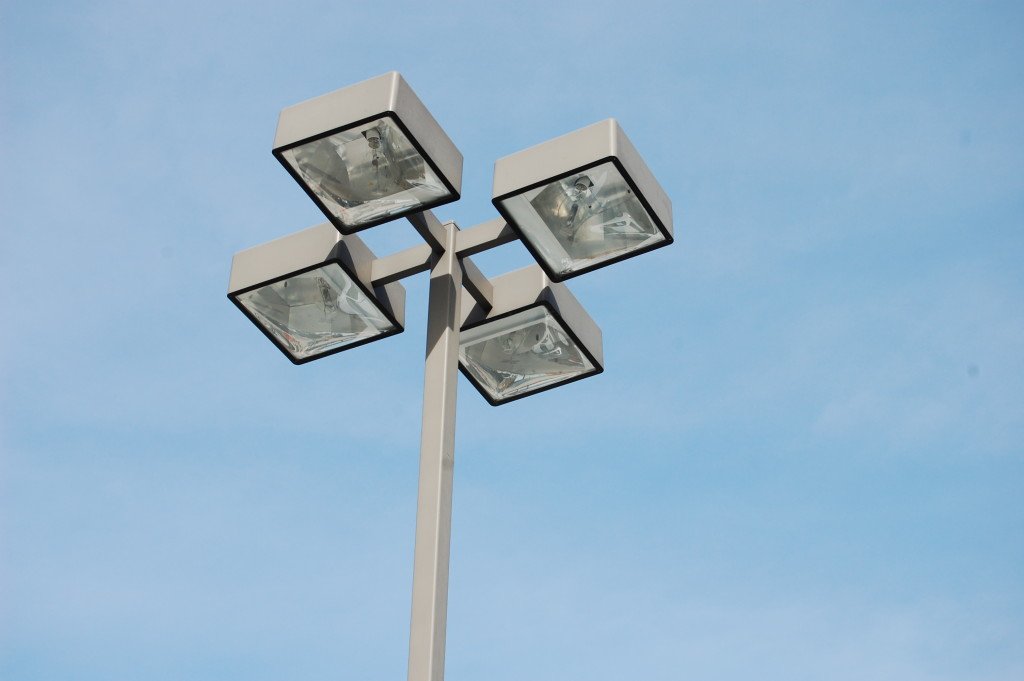
We start with a lighting layout tied to operations: the truck court, the dock apron, the employee lot, the gate, the storage yard and the walks between them. Each area gets a target light level and uniformity, with fixtures shielded to keep glare off adjacent roads and parcels. At the High Plains site, neighbors raised noise and traffic concerns, a reminder that a lit yard is also a neighbor relations issue.
Below grade, we install the conduit and duct banks that carry power and controls to each pole and device. We set concrete bases for poles, pull wire, terminate the fixtures, and test the system with the controls the owner prefers, whether photocell, time clock or a networked lighting controller. Service entrances, meter locations and transformer pads are coordinated with the utility, which sets its own clearance and access requirements. We also leave a documented spare-conduit schedule, so the next electrician knows which sleeves are empty and where each one ends.
Code editions and wind loads
Wyoming's state fire marshal page names the 2026 National Electrical Code for electrical work, though other Wyoming sources still cite the 2023 edition, and the department advises confirming the edition. We confirm with the authority having jurisdiction before we price, and we state the edition on our drawings. Laramie County adopted the 2024 International Building Code effective January 1, 2025, which governs pole bases and structures.
The county's design table lists 105 mph for wind design speed, 32 lb/ft2 ground snow and a 36 inch frost line, all published for residential design. For commercial work, the design criteria appear on the project's code study sheet, so we use those values to size pole foundations. Tall poles in open prairie take real overturning moments, and a pole base that works in a sheltered lot may not work here.
What we manage directly
We schedule and supervise excavation, trenching, forming and pouring of pole bases and equipment pads, conduit and duct bank installation, and backfill and compaction. Subcontracted work is limited to the licensed electrical items that require it, which we coordinate under our schedule. That arrangement keeps the civil trench and the electrical pull on one calendar and avoids the usual finger-pointing over who left a conduit uncapped.
For deeper bases, we use drilled pier foundations that reach below frost and resist overturning. For conduit runs crossing roads or rail, we bore or open-cut by plan, and we reinforce with concrete encasement where the load requires it. Our survey control ties every handhole and duct bank to coordinates, so as-builts are accurate and future work does not guess.
Utility timing and the rest of the yard
Utility coordination is the longest item. Transformer and switchgear lead times can run long, and the utility's design and inspection take time, so we raise the service request as soon as the site plan is fixed. Cheyenne Business Parkway, for instance, has high-volume natural gas, electricity and redundant fiber in place, which shortens the path for parcels there, while undeveloped ground farther out may need extensions.
Lighting also has to fit the rest of the yard: fencing and gates, security systems, truck movements and snow storage. A pole in the wrong place gets hit by a plow or a trailer within a month. We place poles on islands or behind curbs and protect them with bollards where trucks swing close. Cold matters as well: at this elevation, conduit seals, fixtures and drivers are specified for low temperatures, and we pour pole bases with air entrainment and seal the tops so the freeze-thaw cycle does not spall them.
Cost drivers on a yard electrical package
The main cost items are pole count and height, trench length, transformer and switchgear size, and fixture type. LED fixtures cost more up front and less over their life, and with a large yard the energy and maintenance savings are material. We price good, better and best, with the operating cost difference shown. Controls are the quiet cost item: a networked controller with dimming and schedules adds expense at the start and trims the bill for as long as the yard runs, particularly where lights burn through a long winter night.
Trench length is the second lever. A tight layout with poles grouped on a main loop uses less conduit than scattered poles. And if you plan expansion, we size the duct bank and the transformer pad for later capacity, because adding conduit after paving costs many times what an empty spare costs at the start. For distribution center yards with heavy night operations, the right light level avoids both accidents and overspending.
Send the load letter and the site plan
Give us the service size, the yard layout and the operating hours. We will return a lighting plan, a duct bank layout and a price with options.
Common Questions
Who supplies the transformer and meter?
The utility sets the service point and often supplies the transformer, while the owner builds the pad, conduit and trenching. We coordinate the timing, because a pad that is poured late holds up energization.
What light levels does a truck yard need?
It depends on the tasks. Dock aprons and loading areas need higher levels and good uniformity so drivers can see wheel chocks and trailer doors, while storage yards can be dimmer. We lay out each zone separately and verify the levels with a photometric plan.
How do you keep light off the neighbors?
We use fully shielded fixtures, aim them down, and place poles to keep spill off adjacent roads and parcels. We show the spill contours on the photometric plan when a reviewer or a neighbor asks.
Can you add capacity for future expansion?
Yes. We install spare conduits, oversize the handholes and set the transformer pad for a larger unit. The extra cost at the start is small compared with trenching through finished paving later.
Which electrical code edition applies?
The state names the 2026 National Electrical Code while other Wyoming sources still cite the 2023 edition. We confirm with the local authority for your parcel and state the edition on the plans.
Related
Related Services
Related Building Types
Related Industries
Related Service Areas
Ready to talk about your project?
Industrial Construction Services
-
Ground-Up Industrial Construction
Ground-up plants and industrial buildings in Cheyenne and Laramie County, built around utilities, slab spec, wind load and a 36 inch frost line. -
Industrial Design-Build
One contract for design and construction of Cheyenne industrial plants, with guaranteed pricing, early utility release and closely managed site work. -
Industrial Preconstruction Services
Site feasibility, utility review, estimating and scheduling for Cheyenne industrial projects, priced on real quantities before design is frozen.