Electrical Duct Banks and Underground Power in Cheyenne
The Cheyenne Chamber CEO expects local electricity demand to rise about 50% over five years. The same reporting names power supply and transmission as the limits on growth. For an industrial owner, that makes the underground electrical system the most consequential thing built outside the walls. Once the duct bank is poured and backfilled, adding capacity means trenching through your own yard.
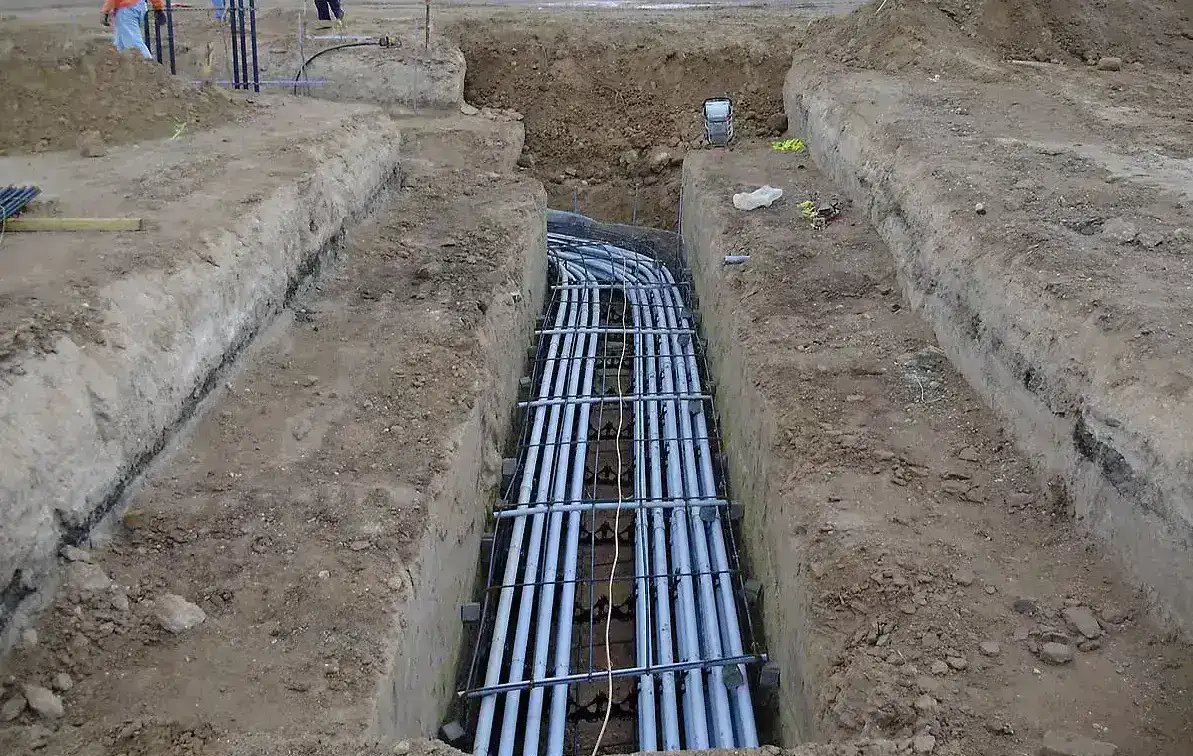
We build electrical duct banks, manholes, handholes, transformer pads, switchgear pads and conduit runs from the utility point of service to the building and across the site. Concrete-encased banks are the norm for medium-voltage feeders and for any path under truck traffic. Direct-buried conduit serves lighter loads.
Spare capacity is the main design question. Conduit is cheap compared with the trenching that surrounds it, so the answer is almost always to build more than day one needs. We help owners decide how many spares, and where to put them.
Duct bank, pads and structures
A typical package starts with the utility's service entrance: a pad-mounted transformer on a reinforced pad with bollards, and a primary duct bank to the utility's point of connection. Secondary conduit runs to the main switchgear, in concrete-encased banks of four, six, nine or twelve conduits, depending on load. Manholes and handholes sit at turns and at spacing set by pull tension and cable length.
Inside the site, branch banks feed distribution transformers, motor control centers, yard lighting, process equipment and building panels. Generator feeders, fuel-system controls and fire pump power are separate circuits in separate conduits, because code and reliability demand physical separation. The yard lighting work detailed under yard lighting and electrical site work ties into the same banks.
Power as a siting factor
Cheyenne Business Parkway lists high-volume natural gas, electricity and redundant fiber optic telecommunications in place. The I-80 corridor through the city follows a major internet backbone along the Union Pacific right of way. A planned $1.2 billion solar project with 1.2 million panels near Cheyenne could supply the hyperscale campus under construction in the High Plains Business Park, and the local electric utility is named as a partner. Compute users come here because the grid, the fiber and the land are available together, and the data center corridor around the I-80 and I-25 junction is where that shows most.
For those users, the underground package carries the reliability promise. Two feeds from separate paths, dual manholes and physically separated banks let a contractor, a backhoe or a failed splice take out one path without taking down the building. Our data center support buildings work uses this design, and so does industrial work for any plant that cannot afford downtime. Owners in the data center industry specify it by default, and a new data center building without it will draw an engineer's comment.
Standards and inspections
Wyoming's fire marshal page names the 2026 National Electrical Code for electrical work, while other Wyoming sources still cite the 2023 NEC. We confirm the adopted edition with the department and the local authority, and build to the strictest requirement that both accept. Burial depth, cover, separation from other utilities, warning tape and spare-conduit rules follow the NEC and the serving utility's own standards, which can be stricter for primary cable.
The utility has its own construction standards for transformer pads, conduit size, bends and pull boxes, and it inspects before energizing. We obtain the utility's drawings at the start and build to them. Electrical inspectors check rough-in before concrete encasement is poured. A bank covered before inspection gets uncovered at our expense, so we hold the pour until the signature is on the card. Cable testing follows installation: megger or very-low-frequency tests on medium-voltage cable, continuity and insulation tests on lower voltage runs, and the results go into the turnover binder.
What we build with our trade partners
Our trade partners excavate, form, place rebar spacers, set conduit and pour concrete encasement. Spacer-supported conduit with proper tie-down prevents floating when concrete is placed. We use red-dyed concrete over primary banks as a warning and pour in controlled lifts to avoid displacing the conduit.
Rigid, PVC and HDPE conduit all have their uses, and the choice depends on the cable type, the depth and the traffic. We use sweeps with long radii for medium-voltage cable and pull a mandrel and a rope through each conduit before closing. Final cap and label go on every run. See also our equipment pads and foundations work, which poured pads to the manufacturer's template for the transformers and gear these banks connect to.
Working near energized lines
Digging near energized lines is a leading source of serious injury. We call for locates, pothole to confirm every crossing, and keep hand-dig zones around marked cables. When a trench crosses an energized primary line, we coordinate with the utility for de-energizing or protective measures. Equipment operators receive overhead-line training, and spotters watch boom clearances near overhead lines during crane picks.
Cold weather brings extra care. Frost heave can shift manholes and pull conduit joints, so we place granular bedding, insulate shallow sections and slope duct banks for drainage. Water in a conduit freezes and can crush cable. Every bank drains to a manhole sump, and every sump has a pump or a path to daylight.
Build the spare conduit now
Send the one-line diagram and the expansion plan. We will price the banks, the pads and the spares.
Common Questions
How many spare conduits should we build?
At least one extra conduit for every two live ones in a primary bank, and more where expansion is planned. The cost of a spare is a small fraction of future trenching. We help set spares from your load forecast.
Why concrete-encased instead of direct-buried?
Encasement protects against dig-ins and heavy loads, keeps conduit in position and meets many utility standards. It costs more, so lighter loads in non-traffic areas may use direct burial where the code and the utility allow.
Who supplies the transformer?
The utility supplies and owns the service transformer in many cases, while the owner supplies the pad and the conduit. Customer-owned transformers are common for larger loads. We confirm the arrangement with the utility during design.
How deep are duct banks buried?
Depth follows the NEC and the utility's standards, and must be below the 36 inch frost line published by Laramie County where freeze is a risk to conduit or cable. The engineer sets final cover.
Can we add capacity later without tearing up the yard?
Yes, if spare conduits and spare space in manholes were included at the start. That is the reason to build them now.
Related
Related Services
Related Building Types
Related Industries
Related Service Areas
Ready to talk about your project?
Industrial Construction Services
-
Ground-Up Industrial Construction
Ground-up plants and industrial buildings in Cheyenne and Laramie County, built around utilities, slab spec, wind load and a 36 inch frost line. -
Industrial Design-Build
One contract for design and construction of Cheyenne industrial plants, with guaranteed pricing, early utility release and closely managed site work. -
Industrial Preconstruction Services
Site feasibility, utility review, estimating and scheduling for Cheyenne industrial projects, priced on real quantities before design is frozen.