Site Utilities Package for Cheyenne Industrial Sites
Water, sewer, gas, power and fiber at the lot line decide which parcel wins. A site with all five in place can have a building permit in hand and a crew in the ground within weeks of closing. A site missing one can wait on a utility board, an easement and a line extension for a year. We build the underground package that connects the building to what the park, the city and the utilities provide.
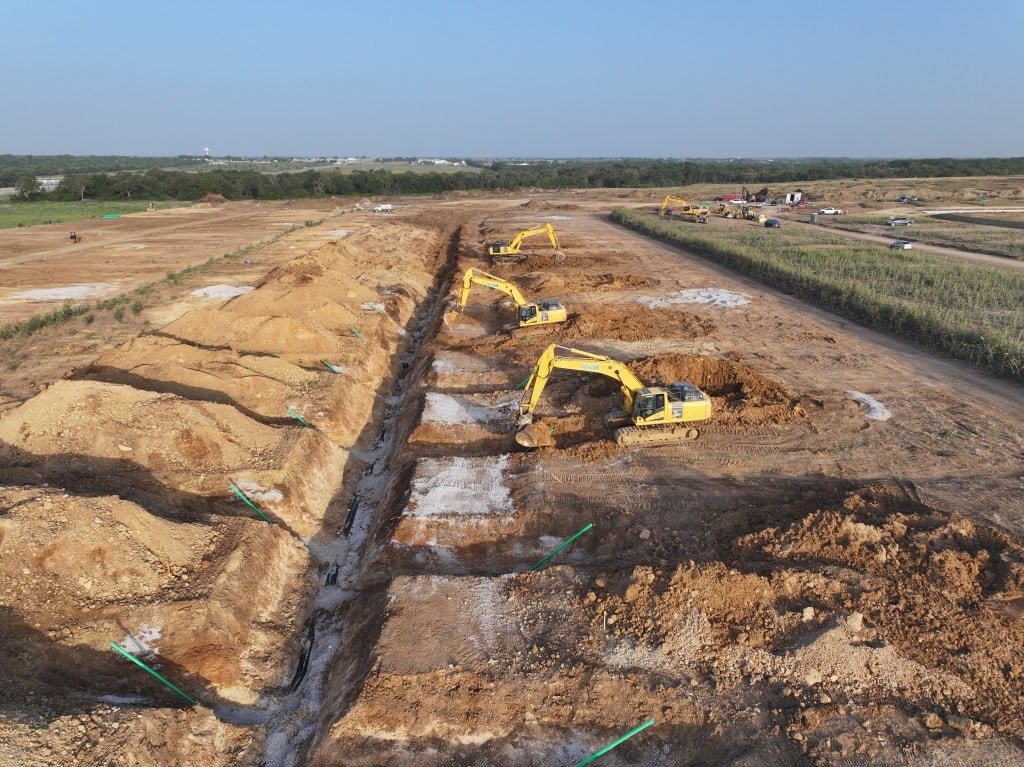
Our site utilities scope includes sanitary sewer, domestic water, process water, natural gas service, storm connections, telecom conduit and the trenches that carry them. We coordinate with each owner of a line: the city for water and sewer, the gas utility for the meter set, the electric utility for the service, and the telecom provider for fiber.
The package is the part of a project that most often falls behind. Good coordination in the first month saves the owner from a stalled opening. We also deliver an as-built set with surveyed invert elevations, tie dimensions to every valve and cleanout, and photographs of each run before backfill, so the plant can find its own lines for the life of the building.
What is already in the ground
Cheyenne Business Parkway has high-volume natural gas, electricity and redundant fiber in place across 900 acres, and Cheyenne LEADS lists 60 acres still available in parcels under 15 acres. The Cheyenne Logistics Hub reports fiber, water, gas, electricity and sewer service, plus rail. At the High Plains Business Park, infrastructure for the first tenant took seven bid packages: two sanitary sewer mains, one water main, a 4.5-mile road and a signal on US Highway 85.
Those facts shape the scope. In a ready park, our package is lateral connections, meter sets and building services. In a less developed area, it also includes main extensions, easements and road crossings. We tell owners which kind of site they are buying before they sign.
The package, line by line
Sanitary sewer starts with the lateral, manholes, cleanouts and a tie to the main, with grade checks at every run. Domestic water includes the tap, the meter, backflow protection and the building entry. Fire water, a separate system with its own sizing, is covered under fire water loops and hydrants. Gas service involves trench, pipe and meter location agreed with the utility. Telecom conduit is laid in banks with pull strings and handholes, and sized for the second carrier.
Process lines come next for plants that need them: compressed air, wastewater pretreatment, process water, glycol or steam. Our trade partners install them in the same trench where practical. Shared trenches save excavation but demand careful separation distances and inspection holds.
Trench safety and locating
Deep trenches are among the most dangerous parts of construction. We shore or slope every trench over five feet, keep ladders within 25 feet of workers, and keep spoil two feet from the edge. A competent person inspects each trench daily and after rain. Our locators mark every existing line and our trade partners pothole to confirm before machines cut.
Near the interstate and rail corridors, abandoned lines and live fiber are common. The I-80 corridor through Cheyenne runs along a major internet backbone that follows the Union Pacific right of way, so cutting a line there is not an option anyone wants. We call in the locate, wait for the marks, and verify.
Why utility costs vary so much
Three items vary: distance, depth and tie-in complexity. A lateral of 200 feet at 8 feet deep is a small job. A 2,000 foot main extension across a road, with a bore under the pavement, is a big one. Bedrock or cobble can multiply excavation cost. Frost depth sets minimum cover for water lines. Laramie County lists a 36 inch frost line depth in its criteria, and water pipes generally need cover below.
Utility fees are a second layer: capacity charges, tap fees, meter deposits and inspection fees. They are set by each provider and can be large. We list them as separate lines in the estimate so no one is surprised. See our yard lighting and electrical site work for the power side.
Users with heavy process demand
Utility packages grow with process intensity. A food and beverage processing plant needs high-volume water, hot-water or steam lines, a wastewater pretreatment tie-in and often a larger gas service for boilers and ovens. A pharmaceutical or lab plant adds purified water loops and strict separation of waste streams. A warehouse needs far less: one domestic tap, one sanitary lateral, a fire service and a modest gas service for heaters.
Operators in pharmaceutical and life sciences also care about redundancy, because a single failed feed can stop a validated process. We lay out dual feeds where the utility allows, with isolation valves that let a section be shut without taking down the whole plant.
Sequence and lead times
Utility work is front-loaded. We coordinate permits, locates and utility applications in the first two weeks. Trenching begins right after mass grading and before footings. Gas and electric tie-ins depend on the utility's crews, and those dates are outside our control. We ask for firm dates in writing and build float around them.
The city's water supply is also a question at larger scales. In a recent report, council members asked whether a proposed large nitrogen plant would draw from the city system or from its own wells in the county aquifer. That question affects design and permits, and we raise it with any user whose process water demand is large. Related work in site clearing and grading and in Campstool Business Park, near the interchange, follows the same order.
Check the lot line first
Send the parcel and the load list. We will return a utility status and a line-by-line price.
Common Questions
Who pays for a main extension?
It depends on the utility's policy and the development agreement. Sometimes the owner pays and is partly reimbursed as other users connect. We help read the policy before you buy land.
How deep do water lines go?
Below frost depth with cover set by the local standard. Laramie County lists a 36 inch frost depth in its design criteria, and water mains are typically deeper. The engineer sets final depth.
Can we share a trench for several utilities?
Often, with required separation between water, sewer, gas and electric. Local rules govern spacing, and the utility owners must approve. Shared trenches reduce cost but raise coordination needs.
What if the utility cannot serve us on our date?
We learn this in preconstruction. Options include phasing the load, using temporary generation, choosing a different site or paying for faster upgrades where the utility allows.
Do you handle fiber?
We install conduit, handholes and pull strings to the building, and we coordinate with the carrier for the fiber itself. Redundant paths are planned when uptime demands it.
Related
Related Services
Related Building Types
Related Industries
Related Service Areas
Ready to talk about your project?
Industrial Construction Services
-
Ground-Up Industrial Construction
Ground-up plants and industrial buildings in Cheyenne and Laramie County, built around utilities, slab spec, wind load and a 36 inch frost line. -
Industrial Design-Build
One contract for design and construction of Cheyenne industrial plants, with guaranteed pricing, early utility release and closely managed site work. -
Industrial Preconstruction Services
Site feasibility, utility review, estimating and scheduling for Cheyenne industrial projects, priced on real quantities before design is frozen.