
Site Clearing and Mass Grading in Cheyenne
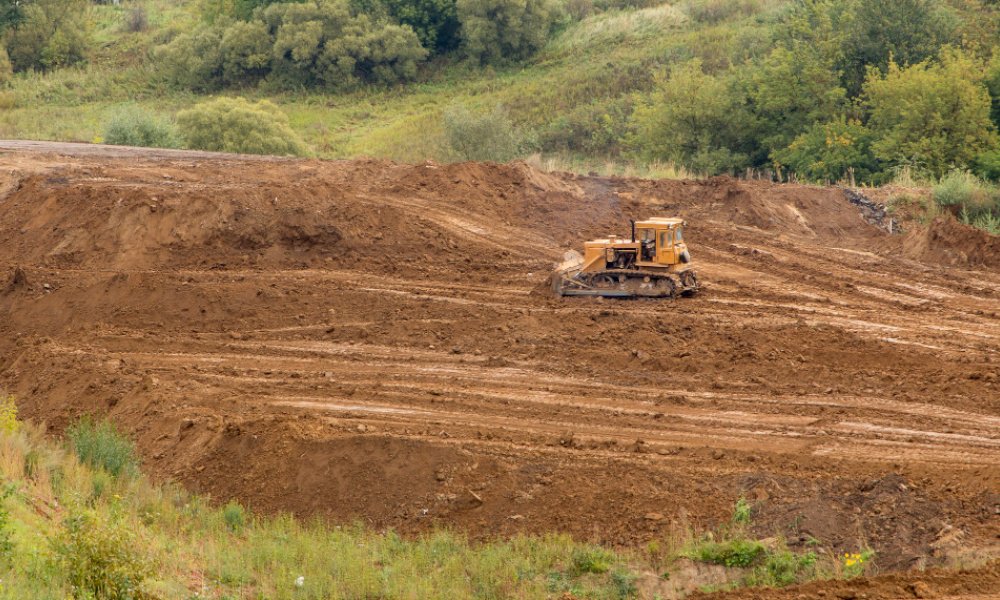
Six inches of rain in 24 hours is the Wyoming record, and it fell on Cheyenne on August 1, 1985. Dry Creek and Crow Creek flooded downtown that night. Any earthwork contractor who works in this city has to treat that storm as a design case, not a story. Mass grading here is as much about where water goes as about where dirt goes.
We clear, strip, cut, fill and shape industrial sites from a few acres to hundreds. The work sets the pad elevations, the drainage paths, the truck routes and the foundation conditions for everything built after. A grading error in month one shows up as a standing puddle in a dock apron or a cracked slab in year three. We hold tolerances of a tenth of a foot on building pads and tighter where the slab spec demands it.
Our grading plan begins with the geotechnical report and the stormwater plan. It ends with a finished subgrade, tested compaction and a pad that drains where the engineer drew it to drain.
Water, wind and the first 12 inches
The topsoil layer on the high plains is thin, dry and easily blown. Stripping and stockpiling it is a dust-control exercise. We use water trucks, tackifier and seed on stockpiles, and we phase clearing so large areas are never bare at once. Wind turns a graded site into a dust source within hours, and neighbors and inspectors notice.
The second consideration is frost. Laramie County's published design table lists a 36 inch frost line depth, so any fill under slabs and footings must be select, compacted and non-frost-susceptible within that depth, or insulated. We test the fill, record the density, and keep a log by lift. A pad built over wet clay without that care will heave in its first winter.
The grading season
Grading runs best from spring through fall. Frozen ground cannot be compacted, and wet spring ground cannot hold equipment. The window between thaw and freeze is the real schedule, and a late start can push foundations into winter. We therefore try to mobilize in the first dry weeks of spring and aim to have pads finished before the first hard freeze.
On large parcels, scale controls the plan. The High Plains Business Park covers 1,100 acres, with a 4.5-mile new road and two sanitary sewer mains built as part of its infrastructure. The logistics hub southwest of the city covers about 2,000 acres. On sites that large, we phase by drainage basin and balance cut and fill within each, so trucks move the least dirt over the shortest haul. See our logistics hub page for more on large-parcel work.
Equipment and crews we schedule
Earthwork is the work we manage most closely. The earthwork equipment package can include scrapers, dozers with GPS grade control, excavators, compactors, motor graders and water trucks. Machine control cuts rework and gets the grade right in fewer passes. A survey crew checks stakes and as-builts, so what we deliver matches the design.
We pair the fleet with stormwater and detention work, since ponds and swales are usually cut during mass grading. Roads, haul routes and laydown pads, covered under heavy-haul access roads, are built early so the rest of the project has dry, firm access in any weather.
What changes the earthwork price
Four items change earthwork cost: cut and fill balance, haul distance, subgrade conditions and compaction spec. A site that balances needs no import and no export, which saves heavy trucking. A site that needs import must find a source nearby, and distances on the plains add up. Soft or wet spots call for over-excavation and replacement.
Rock, caliche or hardpan, if found, slows production and may call for rippers or hammers. We try to learn this in preconstruction through test pits and borings, and we carry unit prices for unsuitable material removal so the owner knows what the surprise would cost before it happens. Moisture conditioning is another line item: dry plains soil often needs water added to reach optimum density, and a wet spring can force the opposite, with discing and drying. Both are priced as time and water, not as vague contingency.
Working safely in cut and fill
Heavy equipment on open ground needs rules. We separate pedestrians from machines, use spotters near utility crossings, and require back-up alarms and cameras on all dozers and scrapers. Trench and slope work follows OSHA excavation rules, with competent persons on site. Before any digging we call for utility locates and pothole confirmed lines, since an abandoned pipe or a live fiber duct is common on sites near the interstate and rail corridors. The site utilities package follows the same rules.
Stockpiles have angle-of-repose limits and sit away from drainage paths. Haul roads are watered, graded and sloped for runoff. Wind gusts above set thresholds stop scraper operations, because visibility drops fast on dry ground.
Why it matters on the current projects
The hyperscale campus on 960 acres in the High Plains Business Park, along South Greeley Highway, shows what grading looks like at scale: an $800 million, 715,000 square foot building, 4.5 miles of new road, two sewer mains and one water main in seven bid packages. A smaller owner will not need that much, but the same logic applies. Earthwork comes first, it controls the critical path, and a good plan saves months.
For power-hungry users like the data center sector and for distribution users like warehouse and storage developers, big flat pads, clean drainage and a stable subgrade for heavy slabs are the baseline. We deliver them with density tests, elevation checks and drainage proofs.
Get the pad right the first time
Send the survey and the geotechnical report. We will return a grading plan and a haul estimate.
Common Questions
How do you control dust on a graded site?
Water trucks, tackifier, seeded stockpiles and phased clearing so large areas are not bare at once. Wind is the limiting factor, and we shut down operations in extreme gusts. Our plan is part of the stormwater permit file.
Can you grade in winter?
Limited work is possible when ground is not frozen, but compaction in frozen conditions is unreliable. For pads that will carry slabs, we prefer to finish before hard freeze, or to protect the subgrade from freezing with insulation blankets.
Do you take care of erosion control and permits?
We install silt fence, check dams, inlet protection and construction entrances as required by the stormwater plan, and we inspect them after storms. Permit filings are coordinated with the owner and engineer.
How is compaction verified?
Third-party testing reports density against the specification for each lift, with failures reworked before the next lift. We keep the results in a log tied to a grid.
Who sets final elevations?
The civil engineer. We stake, cut and fill to the grading plan, check with survey, and report any conflict between plan and field before we pour concrete.
Related
Related Services
Related Building Types
Related Industries
Related Service Areas
Ready to talk about your project?
Industrial Construction Services
-
Ground-Up Industrial Construction
Ground-up plants and industrial buildings in Cheyenne and Laramie County, built around utilities, slab spec, wind load and a 36 inch frost line. -
Industrial Design-Build
One contract for design and construction of Cheyenne industrial plants, with guaranteed pricing, early utility release and closely managed site work. -
Industrial Preconstruction Services
Site feasibility, utility review, estimating and scheduling for Cheyenne industrial projects, priced on real quantities before design is frozen.