Industrial Demolition Services in Cheyenne and Laramie County
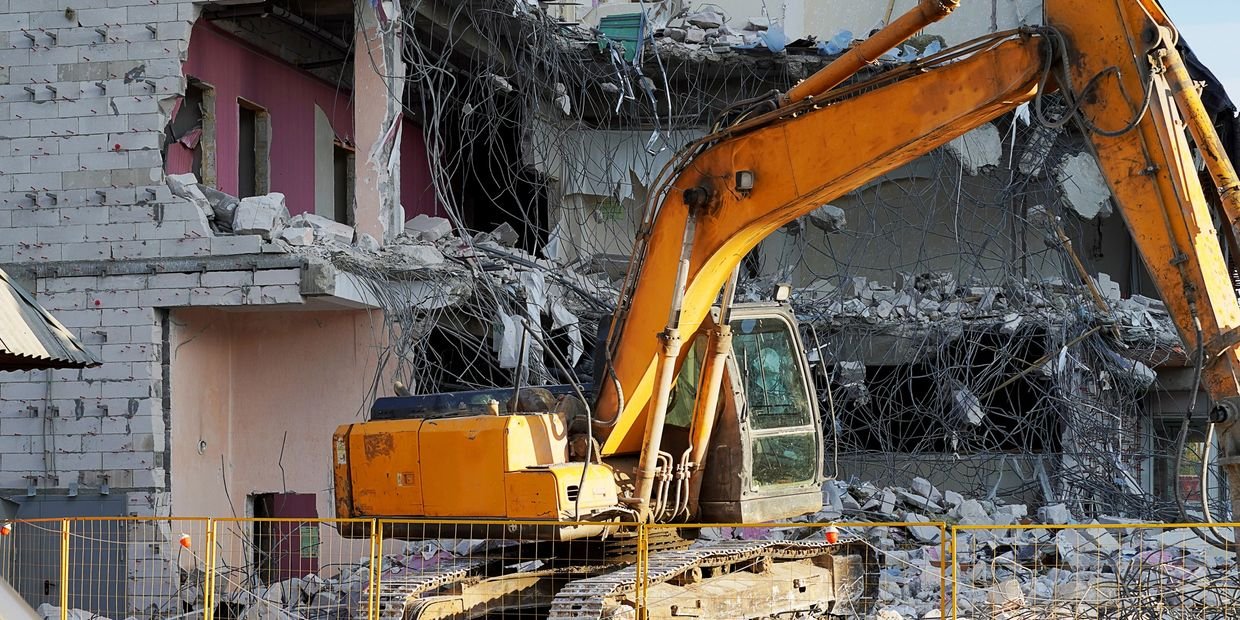
Selective demolition is mostly a survey job. Before a crew arrives with a machine, someone has to know which walls carry load, which pipes are live, what is in the tanks, what coatings are on the steel and where each utility enters the building. Industrial buildings hide more of this than any other type, and the survey is where schedule and safety are won or lost.
We demolish industrial structures and equipment: interior selective removal ahead of renovation, equipment and process-line removal, tank and silo removal, structural steel and masonry buildings, loading docks, canopies, foundations and flatwork. We also clear sites for new construction, leaving a graded, compacted pad with utilities capped and the soil tested where it matters.
We handle the parts around the machine work as well: utility disconnects, permits, dust and noise control, neighbor notices, trucking, recycling of steel and concrete, and restoration of the ground. Owners get a closed-out parcel with a completion package, not a pile of debris.
Why the work shows up here
Cheyenne carries industrial history. Union Pacific and BNSF both run yards in the city, the Union Pacific roundhouse and turntable district covers 113 acres, and downtown has long-vacant sites that the Downtown Development Authority is targeting with a $3.5 million gap financing program for apartments, retail or office. Those parcels have to be cleared before they can be rebuilt, and the depot district is the area where it matters most.
In Platte County, the Laramie River Station is a 1,710 MW coal-fired plant commissioned in 1980, with its last unit online in 1982, employing about 300 people. Industrial plants and buildings of that age are the ones where owners eventually weigh renovation against removal, and the work is sized to match. Wheatland is a small market, but a facility of that scale shows what a removal program can involve.
Permits, existing-building rules and hazmat
The state fire marshal lists the 2024 International Existing Building Code among the adopted family, and it governs partial demolition and alterations to buildings that remain in service. Full demolition needs a permit from the local jurisdiction, utility disconnects confirmed by the providers, and in many cases an asbestos survey and notification before work. Wyoming leaves enforcement to local authorities, so we confirm the process with the building department for the exact site.
Industrial sites add environmental review. Tanks, sumps, transformers, coatings and fill may need testing and special handling. We document what was found and how it was disposed of, and we coordinate with environmental consultants when your lender or buyer needs a clean closeout. Stormwater controls are installed before work begins and stay in place until the site is stabilized.
What our demolition partners do
Our demolition partners run excavators with shears, crushers and breakers, cut steel with torches and saws, and bring down masonry and concrete in controlled stages. We rig and lift equipment with licensed operators, set up exclusion zones and monitor for dust and vibration. Haul-off, sorting and recycling are managed so steel and concrete leave as saleable material where possible.
After demolition, we grade the site, fill voids, compact fill in lifts and test it. If the next use is a new building, we coordinate the pad with site clearing and mass grading so the owner gets a surface ready for foundations. For floors and foundations inside a building that remains, see our work on slab removal and replacement.
Conditions that change the plan
Adjacent operations decide method. Demolition beside a live plant or a rail line is slow and controlled: no free-fall, shielding, dust suppression and vibration limits. In open sites, mechanical methods are faster. Wind matters as well. Dust moves across the prairie in minutes, so we schedule demolition in calm windows when possible, and run water for suppression.
Frost and snow shape the finish. A cleared site left with open trenches and loose fill becomes a hazard in a thaw, so we backfill and compact before winter, and mark any remaining foundations. Hail and high wind have damaged structures in this county, as the August 1, 2025 storm showed, and we check storm-damaged buildings for stability before anyone enters.
Sequence from shutdown to clean pad
The usual order: survey and testing, utility isolation, abatement, interior stripping, equipment removal, structural demolition, foundation removal, backfill and grading. Each step depends on the last, and the utility and abatement steps carry the long lead times. We start permits and utility requests while the survey is under way, so site work begins the day approvals arrive.
We build the schedule backward from the date the next construction needs the ground. If you are clearing a site for a new building, the demolition and the foundations can overlap in separate areas. If you are decommissioning an metals or heavy industry line, we plan around outages and returns of power.
What we take down
Frequent projects include old warehouses and distribution buildings, manufacturing halls, rail-adjacent storage, process structures, and municipal buildings or yards. Each type has its own hazards. Warehouses have racking and sprinkler systems; process buildings have tanks, pits and coatings; rail-adjacent sites have track and ballast.
We also remove old canopies, silos, loading docks and obsolete mezzanines. Some structures can be reused instead of removed, and we say so when a renovation will cost less than a clearing. The utility and power industry page covers sites with substations or switchyards.
Start with the survey
Tell us what stands on the site and what comes next. We will survey, price the removal and give you a closeout schedule.
Common Questions
How long does it take to demolish an industrial building?
Planning and permits usually take longer than the physical demolition. Survey, abatement and utility isolation come first. A mid-size building can come down in weeks once those are done, but we give you a dated sequence after the survey.
Do you handle asbestos and other hazardous materials?
We coordinate licensed abatement contractors and require a survey before work in older buildings. Tanks, transformers and coatings are tested and handled by the proper specialists. We keep the records so your closeout package is complete.
Can you demolish part of a building while the rest operates?
Yes. We build barriers, isolate utilities, control dust and vibration, and work in sequence with your operations. Structural stability is checked at each stage so the part that remains stays safe.
What happens to the debris?
Steel and other metals are recycled, concrete is crushed for fill where specifications allow, and the rest is hauled to approved disposal. We track tonnage and give you the records.
Will the site be ready for new construction?
Yes, if that is the scope. We remove foundations, backfill and compact in lifts, grade to drain and test the fill. Utilities are capped and mapped. We then hand over a pad with a record drawing.
Related
Related Services
Related Building Types
Related Industries
Related Service Areas
Ready to talk about your project?
Industrial Construction Services
-
Ground-Up Industrial Construction
Ground-up plants and industrial buildings in Cheyenne and Laramie County, built around utilities, slab spec, wind load and a 36 inch frost line. -
Industrial Design-Build
One contract for design and construction of Cheyenne industrial plants, with guaranteed pricing, early utility release and closely managed site work. -
Industrial Preconstruction Services
Site feasibility, utility review, estimating and scheduling for Cheyenne industrial projects, priced on real quantities before design is frozen.