
Deep Foundations and Piers in Cheyenne, Wyoming
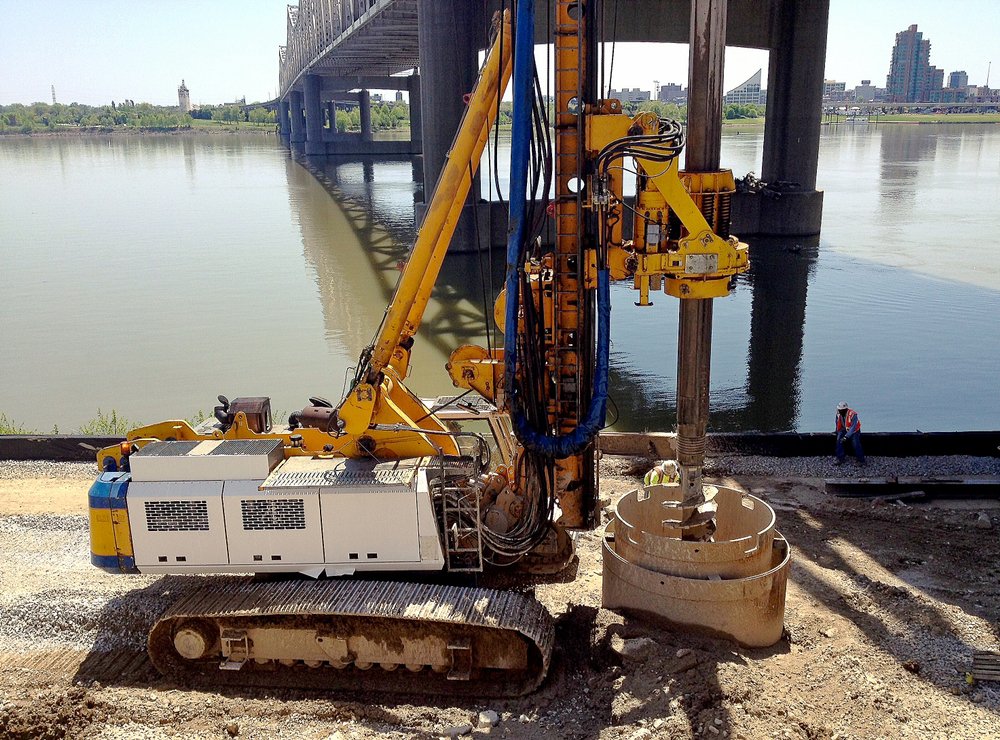
Shallow footings work until they do not, and the borings tell you which side of that line your parcel is on. When a geotechnical report finds fill, soft layers, high groundwater, or loads that a spread footing cannot spread far enough, the building moves to deep foundations: driven piles, helical piers, micropiles or drilled shafts, depending on the load, the soils and the access. We build deep foundations for industrial, data center and warehouse projects in Cheyenne and Laramie County, and we help owners decide early whether they need them.
The decision is financial before it is structural, and it matters most to owners with long, heavily racked buildings. A hall the size of a 715,000 square foot data center, with heavy slab loads and rack lines can run into settlement limits that no spread footing will meet at a reasonable cost. A tilt-wall panel with a tall, slender column line or a crane runway may need deep elements for overturning or uplift. A heavy process unit on thin fill almost always does.
We read the report, price the shallow and deep options side by side, and explain the trade in a page, so the call is not buried in the structural drawings.
Shallow versus deep: how the call gets made
The first question is bearing capacity against the loads. The second is settlement, total and differential, because a building can bear safely and still crack its slab if one side settles more than the other. The third is uplift and lateral load, which matter here, where wind design speeds sit around 105 mph in the county table and tall walls act like sails.
Cost is the fourth, and the one owners ask about first. Deep foundations are typically more expensive per element than spread footings, but a few piers can replace a lot of over-excavation and structural fill. On a site with variable soil, the deep option can also cut risk. We lay out both, with allowances for the unknowns, and give you a range. If you can choose between a pier-supported design and one with a large mat, we give you the schedule effect, not only the unit price.
Laramie County ground and climate
Laramie County sits high and dry, and the design table for the county lists a 32 lb/ft2 ground snow load, 105 mph wind speed and 36 inch frost line. Far to the west, the university town of Laramie sits at about 7,165 feet with about 48 inches of annual snowfall, a reminder that frost and snow loads scale up quickly with elevation across the metro. Heavy industrial owners with press foundations or crane columns feel that first.
The large parcels around the Cheyenne Logistics Hub run to roughly 2,000 acres, and the parkway and North Range parks cover hundreds more. Soils and groundwater vary across that much ground, so one parcel can need piers while its neighbor needs none. Deep elements also decouple the building from seasonal ground movement, which helps near the dock aprons and exterior slabs where freezing takes its toll.
Reports, code and inspection
The geotechnical report is the basis of design. It gives allowable bearing, recommended foundation types, estimated settlement, and pile or pier capacities. The structural engineer then designs to the 2024 International Building Code, which Laramie County adopted with amendments effective January 1, 2025, and the loading rules in its Chapter 16, with criteria shown on code study sheets. Wyoming has no single statewide code, so we confirm the jurisdiction's current amendments with the building department.
Deep foundation work usually requires special inspection, with a third-party inspector on site for installation records. For driven elements, that is driving logs and set criteria; for drilled elements, it is depth, bottom cleanout and concrete volume. We keep the logs on site, review them daily with the inspector, and submit them as a package at turnover, so there is a complete record of every element.
Methods we use and when
Helical piers screw into the ground quickly and suit moderate loads and tight access; they are good for equipment pads, canopies and light structures. Driven piles suit heavier loads and consistent soils; they are fast but noisy and need space. Micropiles go where headroom or access is limited, and in difficult ground. Drilled shafts, covered separately under drilled pier foundations, carry the heaviest loads and resist uplift and overturning.
We pair the method with the site. Our specialty trade partners handle layout, installation, cut-off, pile caps and grade beams, and the tie-in to slabs and walls. We set survey control for each element and check location, plumb and elevation before the cap is formed. Pile caps and grade beams follow in a fixed order: excavate, trim the pile head, place the blinding or formwork, set the reinforcement and anchor rods with a template, and pour. Rushing the template is how a column ends up two inches from its base plate. Tolerance errors at the pile head cost real money when a column base plate has to move.
Fitting piers into the build
Deep foundations go in first, so they set the pace. Mobilization of the rig, the number of elements per day, test pile programs, and curing before cap pouring all take time. We build a production schedule from the element count and the expected rate, and show the owner what each day of delay costs downstream, as tilt panel casting and steel erection depend on the foundations.
Winter work is possible with frost control. We keep excavations short, blanket the work area, and keep the concrete above the temperature the specification demands. Where the schedule is tight, we mobilize two rigs and stagger the pile cap pours so the next trade can start while the last group is still being driven.
Send the geotechnical report
Share the borings and the structural loads. We will price shallow and deep options and tell you which one carries less risk.
Common Questions
How do I know if my site needs deep foundations?
The geotechnical report tells you. If it recommends piers or piles, or shows settlement beyond the building's tolerance, deep foundations are likely. Ask the geotechnical engineer to compare the cost and risk of both approaches.
Are deep foundations always more expensive?
Per element, yes, but they can remove large volumes of excavation, fill and dewatering. On sites with variable soil, they often reduce risk and total cost. We price both when the report allows it.
How much do they affect the schedule?
They come first and set the pace for everything else. A well-planned program can install dozens of elements per day, but test piles and curing add days. We lay out a schedule early so the downstream trades know their start dates.
Do we need to test the piles?
Often yes. The engineer specifies load tests or integrity tests on a sample of elements. We build testing into the schedule and coordinate with the testing agency.
Can deep foundations work in winter?
Yes, with controls. Drilling and driving can go on in cold weather. Concrete placement needs heat and protection, and we plan for it from the start.
Related
Related Services
Related Building Types
Related Industries
Related Service Areas
Ready to talk about your project?
Industrial Construction Services
-
Ground-Up Industrial Construction
Ground-up plants and industrial buildings in Cheyenne and Laramie County, built around utilities, slab spec, wind load and a 36 inch frost line. -
Industrial Design-Build
One contract for design and construction of Cheyenne industrial plants, with guaranteed pricing, early utility release and closely managed site work. -
Industrial Preconstruction Services
Site feasibility, utility review, estimating and scheduling for Cheyenne industrial projects, priced on real quantities before design is frozen.